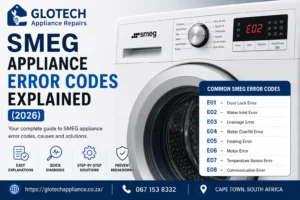
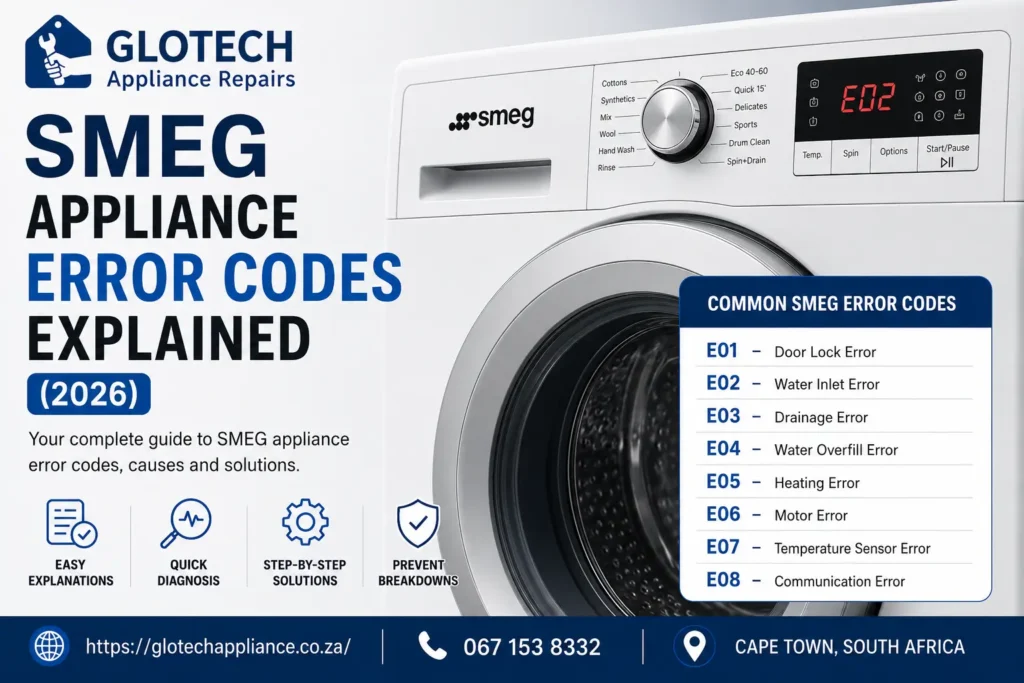
SMEG appliances are known for premium design, modern controls, and strong performance across kitchens and laundry rooms. Whether you own a SMEG washing machine, dishwasher, oven, or fridge, these appliances rely on electronic sensors and control boards to monitor how each system is performing.
When something goes wrong, the appliance may display an error code instead of continuing as normal. At first, this can feel confusing, especially if the code appears suddenly during a wash cycle, cooking programme, or cooling fault. However, error codes are designed to help identify the affected system early, before the fault becomes more serious.
This complete 2026 guide explains the most common SMEG appliance error codes across washing machines, dishwashers, ovens, and fridges. It also explains what the codes usually mean, what you can safely check yourself, and when to call a professional technician.
If your appliance continues to display an error code after basic checks, booking professional appliance repair services near you helps ensure the fault is diagnosed correctly and repaired safely.
Why SMEG Appliances Display Error Codes
Modern SMEG appliances use diagnostic systems to monitor key functions while the appliance is running. These systems are designed to detect abnormal operation and stop the appliance before further damage occurs.
Depending on the appliance type, SMEG error codes may relate to:
• Water supply problems
• Drainage faults
• Heating system failure
• Temperature sensor faults
• Door lock issues
• Motor or pump problems
• Cooling and defrost faults
• Electrical or control board errors
Older appliances often failed without much warning. Modern SMEG appliances, however, use sensors to detect early signs of malfunction. This makes error codes useful because they point you toward the affected system before the appliance suffers a complete breakdown.
For example, a dishwasher that cannot drain may display an error before dirty water causes odours or internal damage. A fridge with a faulty temperature sensor may warn you before food begins to spoil. An oven with a heating fault may alert you before cooking results become unreliable.
Understanding SMEG Error Code Categories
Although error codes vary by appliance model, most SMEG faults fall into a few main categories.
| Error Category | What It Usually Means | Common Appliances Affected |
|---|---|---|
| Water supply error | Appliance is not filling correctly | Washing machines, dishwashers |
| Drainage error | Water cannot leave the appliance | Washing machines, dishwashers |
| Heating error | Water or oven temperature is not reaching target | Washers, dishwashers, ovens |
| Door error | Door is not closing or locking correctly | Washers, ovens |
| Sensor error | Temperature or water level reading is incorrect | Fridges, ovens, washers |
| Electrical error | Control board or wiring fault | All SMEG appliances |
| Cooling error | Fridge cannot regulate temperature properly | Fridges, freezers |
The important thing to remember is that error codes should be treated as warning signs, not final diagnoses. A code can point to the affected area, but proper testing is often needed to confirm the exact faulty component.
SMEG Washing Machine Error Codes Explained
SMEG washing machines rely on water intake, drainage, heating, drum movement, and electronic controls to complete each cycle. When any part of that process fails, the machine may stop and display an error code.
E1: Water Supply Problem
An E1 error usually means the washing machine is not receiving enough water.
Common causes include:
• Closed or partially closed water tap
• Low household water pressure
• Kinked inlet hose
• Blocked inlet filter
• Faulty inlet valve
What you can check first:
• Make sure the water tap is fully open
• Check that the inlet hose is not bent or trapped
• Confirm that there is water supply to the home
• Clean the inlet filter if accessible
If the machine still does not fill correctly after these checks, the inlet valve or internal sensor may need professional testing.
E2: Drainage Fault
An E2 error usually means the washing machine cannot drain water properly.
This is one of the most common washing machine faults and may be linked to a blocked filter, clogged drain hose, or failing pump. If water remains in the drum after a cycle, the problem may be similar to broader washing machine not draining faults.
Common causes include:
• Blocked drain filter
• Clogged drain hose
• Foreign objects in the pump
• Faulty drain pump
• Drain pipe restriction
Signs you may notice:
• Water sitting in the drum
• Cycle stopping before spin
• Clothes coming out soaking wet
• Humming sound during drain cycle
What you can check first:
• Switch off the machine
• Locate and clean the drain filter
• Inspect the drain hose for kinks
• Check for blockages in the outlet pipe
If the error returns, the pump or drainage system may require repair.
E3: Door Lock Error
An E3 error usually points to a door locking problem.
The washing machine will not begin or complete a cycle if it cannot confirm that the door is securely locked.
Common causes include:
• Door not fully closed
• Clothing trapped in the door
• Faulty door latch
• Worn lock mechanism
• Wiring fault
What you can check first:
• Open and close the door firmly
• Remove any trapped clothing
• Check whether the door seal is obstructing closure
If the machine still refuses to lock, the door lock assembly may need replacement.
E4: Overflow Error
An E4 error usually means the appliance has detected too much water inside the drum.
Common causes include:
• Faulty inlet valve
• Pressure sensor problem
• Control board fault
• Water level detection issue
This type of error should not be ignored. If the machine continues filling when it should stop, it can lead to leaks or flooding.
E5: Heating Error
An E5 error usually means the washing machine is not heating water correctly.
Common causes include:
• Faulty heating element
• Temperature sensor failure
• Wiring issue
• Control board fault
Symptoms may include:
• Clothes not washing properly
• Cycle taking longer than usual
• Water remaining cold on heated wash settings
Heating faults require proper testing because the issue may involve electrical components.
E6: Motor Fault
An E6 error may indicate a motor-related issue.
Common causes include:
• Overloading
• Motor wear
• Drum obstruction
• Wiring fault
• Control board issue
If the drum does not turn, stops mid-cycle, or makes unusual noises, stop using the machine until it has been inspected.
Read More:
Defy Washing Machine Error Codes Explained (2026)
LG Washing Machine Error Codes Explained (2026 Guide)
Samsung Washing Machine Error Codes Explained (2026 Guide)
SMEG Dishwasher Error Codes Explained
SMEG dishwashers depend on water intake, drainage, heating, spray pressure, and electronic controls to clean dishes effectively. Error codes often appear when one of these systems fails or becomes restricted.
E1: Water Fill Error
An E1 error usually means the dishwasher is not filling with water properly.
Common causes include:
• Closed water supply
• Low water pressure
• Blocked inlet hose
• Faulty inlet valve
What you can check first:
• Confirm that the water tap is open
• Check the inlet hose for bends
• Make sure the dishwasher is not paused or interrupted
If the issue continues, the inlet valve or water sensor may need testing.
E3: Heating System Fault
An E3 error usually means the dishwasher cannot heat water to the correct temperature.
Common causes include:
• Faulty heating element
• Temperature sensor problem
• Wiring issue
• Control board fault
Symptoms may include:
• Dishes not drying properly
• Greasy residue after washing
• Poor cleaning performance
• Longer cycle times
Because dishwashers depend on hot water for proper cleaning, heating faults should be repaired promptly.
E4: Overflow Protection Activated
An E4 error usually means the dishwasher has detected excess water or a possible leak.
Common causes include:
• Internal leak
• Too much foam
• Faulty inlet valve
• Blocked drainage system
• Water in the base tray
What you should do:
• Turn off the dishwasher
• Avoid running another cycle
• Check for visible water around the unit
If the error remains, professional diagnosis is recommended because internal leaks can damage electrical components.
E5: Drainage Error
An E5 error usually means the dishwasher cannot drain water properly.
This may be caused by a blocked filter, clogged hose, or faulty pump. If water remains at the bottom of the dishwasher, the issue may be similar to dishwasher not draining problems.
Common causes include:
• Food debris in the filter
• Blocked drain hose
• Clogged sink connection
• Faulty drain pump
• Incorrect installation
What you can check first:
• Remove and clean the dishwasher filter
• Check the drain hose for kinks
• Make sure the sink drain is not blocked
If dirty water remains after cleaning the filter, the pump or outlet system may need repair.
E6: Water Intake Fault
An E6 error may indicate that the dishwasher cannot regulate incoming water correctly.
Possible causes include:
• Faulty inlet valve
• Water pressure issue
• Sensor fault
• Control system issue
If the machine fills too slowly, too much, or not at all, the intake system should be inspected.
Related Content: Bosch Dishwasher Error Codes Explained (2026 Guide)
SMEG Oven Error Codes Explained
SMEG ovens use temperature sensors, heating elements, fans, and control boards to regulate cooking performance. Error codes usually appear when the oven cannot control heat safely or accurately.
Err1: Temperature Sensor Fault
An Err1 code usually means the oven cannot read temperature correctly.
Common causes include:
• Faulty temperature probe
• Damaged wiring
• Control board issue
Symptoms may include:
• Oven overheating
• Oven underheating
• Uneven cooking
• Incorrect temperature readings
If your oven temperature is inconsistent, professional testing is usually required.
Err2: Cooling Fan Error
An Err2 code usually points to a cooling fan problem.
The cooling fan helps protect internal electronic components from overheating.
Common causes include:
• Fan motor failure
• Blocked fan
• Wiring issue
• Control board fault
Signs may include:
• Oven becoming unusually hot externally
• Fan not running after cooking
• Error appearing after high-temperature use
A cooling fan fault should be taken seriously because overheating can damage the oven’s control system.
Err4: Door Lock Fault
An Err4 code usually means the oven door lock is not functioning properly.
This is more common on ovens with self-cleaning or advanced safety lock features.
Common causes include:
• Faulty door lock motor
• Door not closing correctly
• Wiring issue
• Control fault
If the oven door remains locked or the oven refuses to start, the lock mechanism may need repair.
Err5: Heating Element Fault
An Err5 error usually indicates that the oven heating element is not working correctly.
Symptoms may include:
• Oven taking too long to heat
• Uneven cooking
• Grill or bake function not working
• Food cooking on one side only
Heating element faults are among the most common reasons customers book SMEG oven repairs. Accurate testing is important because uneven heating may also be caused by a sensor, fan, or control issue.
SMEG Fridge Error Codes Explained
SMEG fridges use sensors, fans, defrost systems, and compressors to maintain stable cooling. When one of these systems fails, temperature can become unstable and food may spoil.
F1: Temperature Sensor Error
An F1 error usually means the fridge temperature sensor is not reading correctly.
Common symptoms include:
• Fridge too warm
• Fridge too cold
• Inconsistent cooling
• Temperature display not matching actual conditions
A faulty sensor can cause the fridge to run incorrectly because the control board receives inaccurate temperature information.
F2: Defrost System Fault
An F2 error usually points to a problem with the automatic defrost system.
Common causes include:
• Defrost heater failure
• Defrost sensor fault
• Timer or control board issue
• Ice buildup around evaporator area
Symptoms may include:
• Excess frost
• Blocked airflow
• Fridge section warming up
• Freezer over-icing
Defrost faults often lead to airflow problems, which can cause symptoms similar to fridge not cooling problems.
F3: Fan Motor Error
An F3 error usually means the internal circulation fan is not working correctly.
The fan distributes cold air through the fridge and freezer compartments.
Common symptoms include:
• Uneven cooling
• Fridge section warm but freezer cold
• Unusual noise from inside the unit
• Frost buildup near vents
Fan issues should be repaired early because poor airflow can affect food safety and compressor workload.
F4: Compressor Protection Fault
An F4 error may indicate compressor strain or abnormal operation.
Common causes include:
• Electrical instability
• Compressor overheating
• Faulty relay
• Refrigerant system fault
• Dirty condenser coils
The compressor is one of the most important components in a fridge. If this code appears repeatedly, the system should be inspected by a technician.
SMEG Error Codes and Load Shedding in South Africa
Load shedding and power fluctuations can affect modern SMEG appliances because many models rely on sensitive electronics.
Power interruptions can cause:
• Control board faults
• Interrupted cycles
• Sensor errors
• Heating faults
• Motor interruptions
• Fridge compressor stress
After a power cut, an appliance may display a temporary fault. In some cases, resetting the appliance may clear the code. However, if the same error returns repeatedly, there may be an underlying issue.
To reduce risk:
• Use surge protection where possible
• Avoid restarting appliances immediately after power returns
• Do not run sensitive appliances during unstable power periods
• Book repairs if errors appear after repeated outages
How to Reset a SMEG Appliance
Some SMEG error codes are temporary and may clear after a reset.
Basic reset steps:
- Turn the appliance off
- Disconnect power at the plug or isolator
- Wait 5 minutes
- Reconnect power
- Restart the appliance
If the code disappears and does not return, it may have been a temporary fault. If the same error comes back, the appliance likely needs diagnosis.
What You Can Safely Check Yourself
Before calling a technician, you can safely inspect a few basic areas.
For washing machines:
• Check water supply
• Clean drain filter
• Inspect drain hose
• Reduce load size
• Make sure the door closes properly
For dishwashers:
• Clean the filter
• Check water supply
• Inspect the drain hose
• Check for standing water
• Avoid excess detergent
For ovens:
• Make sure the door closes fully
• Check whether the oven is receiving power
• Avoid using the oven if overheating occurs
For fridges:
• Check temperature settings
• Make sure vents are not blocked
• Confirm the fridge has power
• Avoid overloading shelves
• Check for unusual frost buildup
These checks may resolve minor issues, but they should not replace professional testing for electrical, heating, compressor, pump, or sensor faults.
When to Call a Professional Technician
You should call a technician if:
• The same error code keeps returning
• The appliance stops mid-cycle repeatedly
• Water is leaking
• The appliance trips power
• The fridge is not cooling
• The oven overheats or underheats
• The dishwasher will not drain
• The washing machine does not spin or drain
• There is a burning smell or electrical fault
Professional technicians can test components properly, identify the root cause, and avoid unnecessary part replacements.
Cost of SMEG Appliance Repairs in South Africa
Repair costs depend on the appliance type, fault, and parts required.
| Repair Type | Estimated Cost Range |
|---|---|
| Minor diagnostic or adjustment | R500 – R1,000 |
| Pump or valve repair | R800 – R2,600 |
| Heating element repair | R1,200 – R3,000 |
| Sensor replacement | R900 – R2,500 |
| Electrical or control board repair | R1,500 – R4,500+ |
| Compressor-related fridge repair | R1,800 – R4,500+ |
SMEG appliances are premium machines, so repairs may require specialist parts and careful diagnosis. In many cases, repair is still more affordable than replacing the appliance, especially when the problem is isolated.
Preventing SMEG Appliance Error Codes
Not all faults can be prevented, but regular care can reduce the risk.
Best maintenance habits include:
• Clean filters regularly
• Avoid overloading washing machines and dishwashers
• Use the correct detergent
• Check hoses and seals
• Keep fridge vents clear
• Clean condenser areas where accessible
• Avoid slamming appliance doors
• Use surge protection
• Schedule servicing when faults start appearing
Preventative maintenance helps your appliance run more efficiently and reduces the likelihood of recurring error codes.
Frequently Asked Questions
What is the most common SMEG appliance error?
Drainage and heating-related errors are among the most common, especially in washing machines and dishwashers. Blocked filters, clogged hoses, heating element faults, and sensor issues are frequent causes.
Can I fix SMEG appliance error codes myself?
You can safely check basic issues such as filters, hoses, water supply, and door closure. However, electrical faults, heating errors, control board faults, and compressor issues should be handled by a professional technician.
Why does my SMEG appliance keep showing the same error code?
Recurring error codes usually mean the underlying fault has not been resolved. A reset may clear the display temporarily, but the code will return if the component or system problem remains.
Is it safe to keep using a SMEG appliance with an error code?
No. Continuing to use the appliance may cause further damage, especially if the fault relates to water leaks, heating, electrical components, or cooling performance.
How do I clear a SMEG error code?
You can try resetting the appliance by switching it off, disconnecting power for 5 minutes, and restarting it. If the error returns, the appliance needs inspection.
Do SMEG error codes mean the appliance is broken?
Not always. Some codes are triggered by simple issues like blocked filters, low water pressure, or open doors. However, persistent codes usually indicate a repairable fault.
Can load shedding cause SMEG appliance error codes?
Yes. Power cuts and voltage fluctuations can affect control boards, sensors, motors, and compressors. Surge protection can help reduce risk.
When should I call a technician for a SMEG appliance fault?
Call a technician if the error code returns after resetting, if the appliance leaks, trips power, stops repeatedly, fails to heat, or no longer cools properly.
Final Thoughts
SMEG appliance error codes are useful warning signals that help identify problems before they become more serious. Whether the issue affects a washing machine, dishwasher, oven, or fridge, the code usually points to a specific system such as drainage, heating, cooling, water supply, or electronic control.
Some basic checks can be done safely at home, such as cleaning filters, inspecting hoses, checking water supply, and resetting the appliance. However, recurring error codes should never be ignored. Premium appliances like SMEG require accurate diagnosis, correct parts, and professional repair methods to maintain long-term performance.
If your SMEG appliance continues to display an error code or is not operating correctly, professional repair is the safest way to restore reliable performance and prevent further damage.